Blog
Common Challenges When Automating a Packaging Line (And How to Avoid Them)
30 October 2026 · Back to the blog
Automating a packaging line is one of the most significant investments a manufacturer can make, and one of the most complex to execute. While the benefits are well-documented, many projects fall short of their original ROI targets, not because the technology fails, but because of avoidable planning and integration mistakes.
Global robot density in manufacturing reached a record 162 robots per 10,000 employees in 2023 – more than double the figure from seven years prior. Despite rapid adoption, implementation challenges remain common. Understanding them before you invest is the most effective way to protect your project.
In this guide, we break down the four most common automation and robotics challenges encountered during packaging line implementation, along with practical steps you can take to avoid them.
Why Packaging Line Automation Is More Complex Than It Looks
Unlike a single standalone machine, a packaging line is an integrated system. Consisting of conveyors, robotics, sensors, vision systems, and software, which must all communicate seamlessly.
Every facility is different, and no two production environments present the same constraints. Floor space, product complexity, SKU range, and target throughput all shape what an effective solution looks like.
Treating automation as a series of individual equipment purchases, rather than as a single coordinated system, is where many projects begin to unravel.
Challenge 1: Integrating New Automation Equipment with Existing Machinery
For most manufacturers, automation doesn’t mean starting from scratch. It means integrating modern industrial automation systems into a production environment with legacy equipment. This is where compatibility issues arise.
Older machinery often lacks the digital interfaces that modern automation equipment expects. Without careful planning, this results in fragmented systems in which components can’t communicate, leading to operational disruption and costly retrofits.
What good looks like:
- Conduct a detailed site survey and compatibility assessment before specifying any equipment. Identify which legacy machines can be digitally integrated and which require hardware modification or replacement.
- Weigh the cost of retrofitting older machinery against the long-term efficiency gains of replacement. It’s not always the cheaper option that saves money.
- Work with integration specialists who have demonstrable experience connecting mixed-generation hardware and software into a unified system.
Challenge 2: Poor Conveyor System Design Creates Production Bottlenecks
Conveyors are easily treated as an afterthought, a way to link machines rather than a critical component of the line. This is a costly assumption.
Even the most capable automated packaging machines will underperform if the product isn’t delivered to them consistently and at the right spacing. Poor conveyor system design leads to excessive accumulation, product misalignment, and throughput restrictions that ripple across the entire line.
Our recommendations:
- Design your conveyor system around your specific production requirements and throughput goals from day one, not around whatever standard modules are available.
- Build in sufficient buffer capacity to absorb minor interruptions without stopping the entire line.
- Account for your product’s physical characteristics, such as size, weight, and fragility, to prevent damage or misalignment in transit.
- Choose modular conveyor systems that can be reconfigured as your product range evolves.
Challenge 3: Choosing the Wrong Automated Packaging Machines
Selecting equipment based on purchase price is one of the most expensive mistakes in packaging automation. Under-specified machines struggle with throughput, create obstacles, and generate hidden costs that quickly wear down any savings.
The smarter approach:
- Match equipment to your actual production goals, not a best-case estimate. If your volumes fluctuate or your SKU range is wide, that needs to be reflected in the specification.
- Prioritise scalability. Modular automated packaging machines can be reconfigured or expanded as demand grows, avoiding the need for full line replacement further down the road.
- If you run multiple SKUs, changeover speed is critical. Specify equipment that supports rapid and repeatable format changes to maintain continuous high-speed operations.
- Factor in long-term maintenance requirements and aftercare support when selecting a supplier. The relationship doesn’t end at installation.
Challenge 4: Underestimating Training, Testing and Commissioning
Investing in the right automation equipment is only half the equation. How that equipment is commissioned and how well your team is prepared to operate it determines whether your line performs to specification in the real world.
Factory acceptance testing (FAT), conducted at the supplier’s facility before shipment, is a critical step in verifying that equipment meets your bespoke design specifications prior to arrival on site. Once installed, further site acceptance testing (SAT) should confirm the system performs under actual production conditions.
Beyond the technology, the workforce transition deserves equal attention. As manual tasks are replaced by automated processes, operators need to be upskilled for monitoring, fault-finding, and maintenance roles. Neglecting this creates dependence on external support and slows the line’s progress toward full productivity.
What we recommend:
- Insist on factory acceptance testing before any equipment leaves the supplier’s facility.
- Plan for a structured commissioning and site acceptance testing period. Don’t expect the line to run at full capacity from day one.
- Invest in operator training as part of the project, not as an optional add-on.
- Work with a supplier who offers ongoing aftercare and structured maintenance plans, so your team has expert support as the line matures.
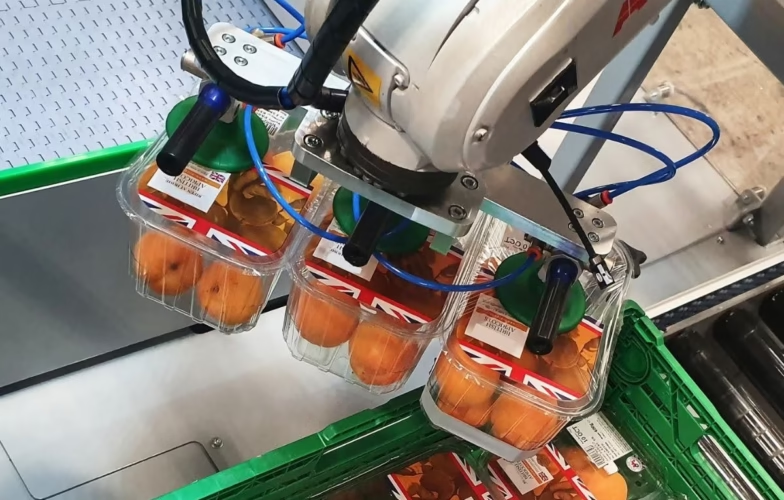
How to Approach Packaging Line Automation Confidently
The majority of automation and robotics challenges are avoidable with the right preparation and the right partners. Across all four challenges above, a common thread appears: early-stage planning and specialist involvement make the difference between a project that delivers and one that disappoints.
Before committing to any equipment, establish clear production goals including target throughput, SKU range, changeover requirements, and growth plans. Use these to drive equipment selection, not the other way around.
Engage automation specialists early. A bespoke approach, underpinned by detailed site surveys and compatibility assessments, will surface constraints and risks before they become expensive problems.
And when selecting a supplier, look for one that offers end-to-end capability: design, integration, commissioning and maintenance.
At RMGroup, we design and integrate bespoke industrial automation systems for packaging operations across a wide range of industries. If you’re planning an automation project and want to get it right from the start, get in touch with our team.